
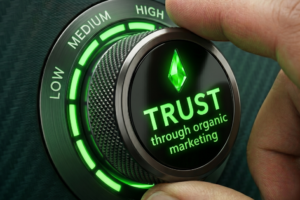
 Your marketing funnel might be bleeding money on paid ads while missing the foundation that makes them work. Relying solely on paid advertising creates trust gaps, drives up acquisition costs, and leaves you without sustainable growth. Organic content fills these critical holes by building credibility, creating discovery touchpoints, and supporting your paid campaigns with better performance. This guide shows you why marketing funnels fail without organic content and, especially, how to fix yours by strategically combining paid and organic efforts for sustainable results.
Why Marketing Funnels Fail Without Organic Content
Paid Ads Alone Create Trust Gaps
Advertising doesn’t build trust. A Nielsen study found that paid advertising scored lowest on the trust continuum, while recommendations from known sources earned trust from 92% of consumers [1]. Business leaders consistently overestimate how much consumers trust their brands. In 2024, 90% of executives believed consumers trusted their business, but only 30% of consumers actually did [1]. That gap widened by 3 percentage points between 2022 and 2023 [1].
Paid ads promise reach, but they can’t manufacture credibility. Wells Fargo spent on trust-building advertising campaigns, yet the company reported a 53% fall in fourth quarter profit with litigation costs reaching $15.61 billion [2]. Facebook invested $382 million in advertising to rebuild trust, and the campaigns failed to move perception [2]. Throwing money at paid media doesn’t fix a trust deficit because audiences don’t accept brand messaging at face value anymore.
No Foundation for Retargeting Efforts
Retargeting delivers results, but only when visitors have somewhere to retarget from. Without organic content creating initial touchpoints, your retargeting pool stays empty. Retargeting ads achieve click-through rates of 0.7%, ten times higher than typical display ads at 0.07% [3]. They produce a 400% increase in engagement and make users 70% more likely to convert compared to non-retargeted ads [3].
The problem intensifies as third-party cookies disappear. Safari and Firefox block third-party cookies by default, and Chrome continues phasing them out [3]. Organic content on your owned properties creates first-party data that survives these changes. Retargeting works because it targets warm audiences who demonstrated interest [4]. In fact, 97% of first-time website visitors leave without converting [4]. Without organic content driving that initial visit, you’re locked out of re-engaging them.
Higher Customer Acquisition Costs Over Time
Paid-only strategies face compounding cost pressures. Customer acquisition costs skyrocketed across B2B channels as paid media costs stayed elevated after peaking in Q1 2026 [1]. The cost of securing a marketing qualified lead for MSPs running paid ads on Google and Bing averaged $2,428.76 [1]. At a 33% close rate, that translates to $7,286.28 in ad costs per new customer [1]. At 25% close rate, the cost jumps to $9,715.04 [1].
Facebook ad costs increased 89% between 2020 and 2021, with average CPM hitting $11 [5]. Best-in-class MSPs spend north of $27,000 for fully burdened customer acquisition when accounting for all marketing and sales expenses [1]. Smaller businesses whose customers spend less than $2,500 monthly can’t afford to compete in paid search because the math doesn’t work [1]. Organic content provides a lower-CAC alternative since it doesn’t involve ongoing ad spend for each visitor.
Missing the Brand Awareness Layer
Marketing funnels need an awareness stage where potential customers discover your brand before they’re ready to buy. Awareness creates the foundation for consideration and conversion stages [6]. Companies rush through this phase, pushing for conversions without proper groundwork, which leads to wasted resources and missed relationship-building opportunities [7]. Without laying groundwork in the awareness stage, converting in later stages becomes difficult [7].
Organic reach declined sharply across platforms as algorithms prioritized paid content. On Facebook, fewer than 6% of followers see an average post, while Instagram shows content to around 7.6% [3]. Zero-click searches grew by over 20% in the past three years, reducing opportunities for lead capture as search engines answer queries directly in results pages [3]. Businesses reported up to a 30% drop in traffic for informational queries that traditionally fed the marketing funnel [3]. Paid ads can’t replace this awareness layer because they target people already in-market, missing everyone earlier in their journey.
What Organic Content Does For Your Marketing Funnel
Builds Credibility and Authority
Organic content positions your brand as a trusted voice in your industry. Thought leadership content drives real business outcomes: 48% of companies awarded business to an organization after engaging with their thought leadership material [4]. More striking, 54% made purchases for products they hadn’t previously considered after consuming authoritative content from that company [4].
B2B decision-makers weight this content heavily. In fact, 64% say thought leadership offers a more trustworthy basis for assessing capabilities than marketing materials or product sheets [8]. Search engines reward this authority through higher rankings, which feeds a positive loop where strong SEO boosts visibility, visibility brings visitors, and engagement signals further improve rankings [8].
Creates Multiple Touchpoints For Discovery
Cold prospects need as many as 50 touches to convert. Organic content creates these touchpoints across search results, blog posts, social media, and third-party mentions. Each interaction shapes how your brand gets understood, remembered, and acted upon.
Pre-purchase touchpoints span organic search results, SEO-optimized content, educational blog posts, landing pages, paid and organic social media, third-party reviews, and word-of-mouth. Your job at this stage centers on showing up early, clearly, and credibly across every channel where discovery happens. Misaligned messaging or missing information stalls momentum before it starts. By the same token, consistent value across touchpoints builds trust and qualifies leads before they reach sales.
Supports Paid Campaigns With Better Quality Scores
Paid ads deliver instant traffic while organic content builds credibility and sustainable growth. The combination produces faster lead generation, lower cost per acquisition, and compounding ROI over time. Specifically, SEO reveals high-converting keywords and content trends that improve paid keyword targeting and ad copy relevancy, which increases quality scores and lowers costs.
Rich keyword data from paid campaigns informs organic strategy. Impression and impression share columns calculate total monthly search volume for specific terms, arming SEO efforts with knowledge about which keywords matter most. Boosting top-performing organic content with paid ads amplifies reach and engagement while saving on acquisition costs.
Generates Long-term Compound Returns
Content marketing delivers compound growth that outpaces campaign-by-campaign approaches over time. Blog posts continue attracting traffic from SEO and social channels long after publication. Core readership for content libraries grows 8% monthly, while spike traffic from viral posts grows 10% monthly [7].
Evergreen content keeps gaining traction through shares, saves, and comments, ensuring visibility expands over time. Well-optimized blog posts attract visitors for months or years, driving organic traffic without continued advertising investment. As websites build libraries of high-performing content, domain authority increases, making future content easier to rank. Content becomes a digital asset that works continuously without additional cost, making marketing sustainable over the long run.
How Paid and Organic Strategies Work Together
Paid Ads Provide Immediate Data for Organic Strategy
Paid campaigns function as intelligence operations for your organic strategy. Running targeted ads reveals which keywords convert, which messaging resonates, and which landing pages perform within weeks instead of months. A manufacturing company testing variations like “precision CNC machining” versus “aerospace component manufacturing” discovered one term converted three times higher within two weeks, directing their organic content focus immediately.
High-converting keywords from PPC campaigns guide blog content, landing pages, and on-site optimization. Successful ad headlines translate into blog post titles, while video hooks that perform well in paid social inform organic content calendars. Campaign data delivers immediate information on audience preferences and message testing that reduces risk in organic efforts.
Organic Content Improves Paid Ad Performance
Brand awareness makes performance campaigns work harder at the bottom of the marketing funnel. Paid ads help brands increase brand awareness by 33%, and when users recognize your brand through paid exposure, they search for you by name later. Those branded searches feed organic traffic while the engagement signals quality to search engines.
Platforms prioritize signals that already exist, meaning they compete aggressively for known intent. Without brand-driven demand entering the system, AI simply reallocates spend toward the same audiences, driving costs upward and compressing returns. Organic content creates this demand foundation that paid systems amplify.
Retargeting Connects Both Channels
Retargeting turns organic visitors into conversion opportunities through paid ads. Tracking pixels enable platforms to create lookalike audiences that mirror attributes of website visitors, page followers, newsletter subscribers, and purchasers. Users shown an ad often browse the organic profile to learn more about the brand before converting.
Customer journeys include multiple touchpoints spanning profile visits, page views, and abandoned carts. Retargeting ads remind users to return and complete actions they started. Specifically, this works because you’re re-engaging warm audiences who demonstrated interest through organic channels first.
The Brand Multiplier Effect
Research shows that combining brand and performance efforts increases ROI by 90% [3]. Brand marketing alone outperforms performance marketing, but integration multiplies growth beyond either approach individually. High brand awareness makes performance campaigns more effective, while performance tactics capture and convert the demand that brand builds.
The multiplier effect operates as a model, not a budget split. It requires alignment across planning, creative, measurement, and incentives. Organizations treating it as a media ratio miss the point, while those embedding it into team collaboration unlock compounding returns across the marketing funnel. In fact, over-prioritizing performance at the expense of brand creates a performance penalty where revenue returns drop between 20% and 50% [3].
How to Fix Your Marketing Funnel with Organic Content
Start With Content that Answers Customer Questions
Publishing content without understanding what your audience actually searches for wastes time and budget. The most important rule in SEO requires a dedicated page answering a singular question better than any competitor in your area. Stop targeting generic keyword phrases. Write content addressing specific questions potential customers ask.
Free tools like AnswerThePublic reveal exact questions people type into Google around your keywords. Search “marketing agency” and you’ll see queries like “How much does a marketing agency cost?” and “Is a marketing agency worth it?”. Each question becomes a blog post, video, or guide that addresses customer pain points while improving SEO performance.
Use Paid Campaign Data to Guide Organic Topics
Paid campaigns reveal which keywords convert and which messaging resonates within weeks instead of months. Evaluate high-performing keywords based on click-through rates and incorporate them into headlines and page titles. This approach helps content connect with users who already demonstrated interest through paid clicks.
Test with pay-per-click ads for real-time learning, then apply high cost-per-click keywords to SEO strategy to reduce ad spend. Use impression and impression share data from paid campaigns to calculate total monthly search volume for specific terms, which guides organic content priorities.
Boost High-performing Organic Content with Paid Ads
Amplify posts that already gain traction organically. If a blog post attracts engagement, promote it through PPC or social media ads to extend reach. No amount of paid promotion compensates for poor-quality content, so paid amplification works only on content performing well organically.
Create custom paid social ads and run A/B tests to optimize results, then use learnings to update and optimize organic content. This strategy saves acquisition costs while scaling reach for proven content pieces.
Create Consistent Messaging Across Channels
Customers who trust a brand will buy again 88% of the time, and trusted companies outperform peers by up to 400% in market value [21]. Consistent messaging builds this trust. In light of siloed teams operating independently, inconsistencies naturally emerge even with detailed guidelines.
Deploy centralized brand consistency frameworks where all teams work from the same strategic narrative and core messaging. Prior to launching campaigns, ensure marketing, PR, and customer experience align around shared brand pillars rather than channel silos.
Implement Tracking Pixels for Retargeting
Tracking pixels are small code snippets that run when pages load, recording who visited each page on your site. Platforms like Google and Facebook aggregate visitors into lists you can target with specific advertisements later. This creates higher purchase likelihood since you’re targeting people who already showed interest.
Build Lookalike Audiences From Organic Visitors
Lookalike audiences help reach new people similar to your best existing customers. You need a source audience with at least 100 people, though 1,000 to 5,000 works better. These audiences mirror demographics, interests, and behaviors of current customers, increasing conversion likelihood. Create lookalike audiences from organic followers, website visitors, and email subscribers to expand reach efficiently.
Measuring Success When Combining Paid and Organic
Attribution determines which marketing activities drive conversions, but choosing the right model matters. Multi-touch attribution distributes credit across all touchpoints in the customer journey rather than crediting only the last click. In fact, 52% of marketers use multi-touch attribution, and they report higher satisfaction when tracking campaign spend and allocating budgets compared to marketers who don’t [26].
Track ROI Across Both Channels
Calculate ROI using the formula: (Revenue from Channel – Cost of Channel) ÷ Cost of Channel × 100. A 3:1 return serves as the baseline most growth marketers use. Track both immediate ROI and projected lifetime value ROI for each channel, since some channels acquire customers with lower immediate purchase values but higher retention rates.
Monitor Customer Acquisition Cost
True CAC equals (Direct Channel Costs + Allocated Shared Costs + Sales Costs) ÷ Attributed Customers. Simple CAC calculations underestimate true costs by 40-45%, leading to budget misallocation [7]. Break down CAC by channel to identify your most efficient acquisition sources, then account for time lag between ad spend and customer conversion.
Analyze Organic and Paid Touchpoints in the Customer Journey
Map touchpoints across the entire marketing funnel so each channel receives proportional credit. Customer journey analysis moves beyond last-click attribution to show how different touchpoints work together to create conversions. This allows effective budget allocation by investing in what works and cutting what doesn’t.
Your marketing funnel doesn’t have to choose between paid ads and organic content. In reality, they work best together. Paid campaigns deliver immediate results and valuable data, while organic content builds the trust and authority that make those campaigns perform better. Start by creating content that answers real customer questions, then use your paid campaign data to guide which topics deserve more focus. Boost what’s already working organically with strategic ad spend. Most compelling evidence shows that brands combining both approaches see 90% higher ROI than those relying on either alone. The foundation you build with organic content today becomes your competitive advantage tomorrow.
Our Online Marketing Packages Include The Content That Will Have Your Online Visitors Trusting You Before They Even Contact You.
We create a comprehensive Internet Presence for our clients using a website that converts, blogs, featured work posts, search engine optimization, social media, email marketing, online reviews, video podcasts, videos, graphic design, and more. Online visitors want to have a meeting with you without having a meeting with you and that is what video and our content marketing does for your lead generation.
> Learn More
Contact us (859-904-8035) today to get started!
—
ABOUT MAIN STREET MARKETING
 Since 2006, Main Street Marketing has been creating Internet Presence Solutions for small businesses. Main Street Marketing uses internet marketing, search engine optimization, social media, lead generation, and video to create a true Internet Presence for its clients. When integrated correctly, this core group of services provide results together that none of the services could provide on their own or in phases.
>> Learn More