
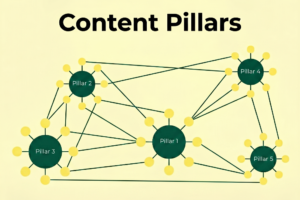
 Traditional SEO focused on ranking individual pages in search engines. AI-powered search platforms such as Google Gemini, ChatGPT, and Microsoft Copilot are changing how people discover businesses. Instead of clicking through multiple search results, users ask questions and receive direct answers generated from trusted sources across the internet. Content pillars are one of the most effective ways to help AI systems understand your expertise, trustworthiness, and relevance.
What Is a Content Pillar?
A content pillar is a comprehensive page focused on a broad topic that is important to your business. Supporting articles, videos, FAQs, case studies, and service pages are linked back to the pillar topic.
For example, a family law firm might have:
Pillar Page
-
- Family Law Services
Supporting Content
-
- Child Custody Laws
- Parenting Plans
- Divorce Mediation
- Child Support Calculations
- Grandparents’ Rights
- Modifying Court Orders
- Relocation Cases
- High Net Worth Divorce
Together, these pages create a topical authority cluster that demonstrates expertise.
Why AI Platforms Prefer Content Pillars
AI models are designed to identify sources that consistently cover a topic in depth.
When AI systems analyze websites, they look for:
-
- Topic expertise
- Content depth
- Internal linking structure
- Consistency of information
- Supporting evidence and examples
- Clear answers to user questions
A company with 50 interconnected articles about one subject is often viewed as more authoritative than a company with 50 unrelated blog posts.
Content Pillars Build Topical Authority
Topical authority occurs when your website becomes recognized as a trusted source on a specific subject.
For example:
Roofing Company
Instead of publishing random blogs, build a pillar around:
Residential Roofing
Supporting articles:
-
- Roof Repair
- Roof Replacement
- Storm Damage
- Insurance Claims
- Metal Roofing
- Tile Roofing
- Shingle Roofing
- Roof Inspections
- Hurricane Preparation
When someone asks:
“How do I know if I need a new roof after a hurricane?”
AI systems can confidently reference content from a website that has thoroughly covered every aspect of residential roofing.
AI Looks for Context, Not Just Keywords
Traditional SEO often focused on ranking for specific keywords.
AI platforms focus on understanding topics and relationships between concepts.
Instead of targeting only:
-
- Roof Repair Miami
You should also create content around:
-
- Roof leaks
- Storm damage
- Insurance claims
- Wind mitigation
- Roofing materials
- Roof lifespan
- Maintenance schedules
This creates a complete knowledge base that AI can use to answer many related questions.
Content Clusters Increase Citations
AI-generated answers frequently pull information from websites that provide:
-
- Direct answers
- Detailed explanations
- FAQs
- Step-by-step guides
- Definitions
- Examples
- Case studies
The more comprehensive your content ecosystem becomes, the more opportunities AI systems have to reference your information.
Think of every supporting article as another entry point into your website’s expertise.
FAQ Content Is Critical for AI Discovery
Many prompts entered into AI platforms are phrased as questions.
Examples:
-
- How much does a roof replacement cost?
- What happens during divorce mediation?
- How often should landscaping be updated?
- What is the probate process?
Every pillar should include extensive FAQ sections.
These FAQs should:
-
- Answer questions directly.
- Use conversational language.
- Include related questions.
- Link to deeper supporting content.
This structure mirrors how people interact with AI systems.
Content Pillars Create Better Entity Recognition
AI platforms increasingly organize information around entities rather than keywords.
An entity can be:
-
- A company
- A service
- A location
- A person
- A product
- An industry concept
When your website repeatedly connects your company with a specific subject, AI becomes more likely to associate your brand with that expertise.
For example:
A roofing company consistently publishing content about:
-
- Roof repair
- Roof replacement
- Storm restoration
- Insurance claims
strengthens the connection between the company and residential roofing expertise.
Pillars Support Every Marketing Channel
A strong content pillar fuels:
Search Engines
-
-
- Google rankings
- Bing rankings
-
AI Search
-
-
- ChatGPT Search
- Gemini
- Copilot
- Perplexity
-
Social Media
-
-
- LinkedIn posts
- Facebook content
- Instagram reels
- YouTube videos
-
Email Marketing
-
-
- Main newsletter topics
- Industry-specific newsletters
-
Podcasts
-
-
- Guest discussion topics
- Episode themes
- Video clips
-
One pillar can generate dozens of content assets.
The Future: Building Knowledge Libraries
Companies that win in AI search will stop thinking about creating isolated blog posts and start building comprehensive knowledge libraries.
The goal is not simply: “Rank for a keyword.”
The goal becomes: “Be the most complete online source for a topic.”
When AI systems need information, they look for trusted, comprehensive sources. Content pillars, supported by clusters of related content, help establish that trust and authority.
The Formula
For every major service:
-
- Create one comprehensive pillar page.
- Create 10–30 supporting articles.
- Add FAQs to every page.
- Link all content together.
- Publish videos on the same topics.
- Discuss the topics in podcasts.
- Share the content through newsletters and social media.
- Continuously update content with new information.
The businesses most likely to be cited by AI platforms over the next several years will be those that create the deepest, most interconnected content libraries within their industries.
What Are Content Pillars?
What are content pillars, and why should you care about them? Your content marketing strategy will be unfocused and all over the place without content pillars. Content pillars are themes or topics that are the foundations of your content strategy. These foundational themes guide all content creation efforts and help brands focus their messaging on themes central to their identity. We’ll walk you through what a content pillar is, how to build a pillar content strategy that works, real-life content pillars examples, and how to measure your results in this piece.
Content Pillars as Core Themes
Content pillars are the main topics your business regularly publishes content around on your website, social media and other platforms. They’re broad theme areas that reflect your brand’s priorities and speak directly to what your audience cares about most.
Think of them as the main “buckets” under which all your content will fit. People also call them content buckets or content categories. These themes are brand-specific and give you a content skeleton for creating and managing content.
A wellness brand might use pillars like nutrition, movement, mindfulness and lifestyle habits. A health and fitness brand could center their strategy around nutrition, exercise and mental health. Each piece of content you create should fit with at least one pillar and tie back to your brand’s mission, values or expertise.
Most brands benefit from having three to five content pillars. This range gives your team a clear focus while still allowing room for creativity and flexibility. Your pillars should be broad enough to support a variety of content but specific enough to keep your strategy focused.
Content Pillars vs Pillar Pages
Here’s where things get confusing. Some marketers use the term ‘content pillars’ to refer to pillar pages. These are two different concepts.
Pillar pages are webpages that explore core topics in-depth. These detailed, authoritative pages about a certain topic want to answer all questions related to that particular subject. Pillar pages should link to (and be linked from) cluster pages that explore related subtopics. A pillar page and its cluster pages create a topic cluster together.
A digital marketing agency might decide that SEO is one of their content pillars. So they create an SEO topic cluster containing a pillar page entitled ‘The Ultimate Guide to SEO’ and various cluster pages covering subtopics like keyword research, link building and technical SEO.
There are three main types of pillar pages: the ‘Guide,’ the ‘What Is’ and the ‘How-To.’ The Guide pillar page offers detailed coverage of a topic from start to finish. The ‘What Is’ pillar defines and explains a concept. The How-To pillar page seeks to inform readers and give them the ability to accomplish a task or solve a problem.
Interlinking your cluster content to your pillar page (and between cluster pages) remains needed for your information architecture. This structure showcases your expertise on the topic, and the interlinking gives context to search engines.
How Content Pillars Organize Your Strategy
Content pillars give you a clear framework instead of posting random content or chasing trends. They help you plan with intention. This keeps your messaging consistent and prevents you from repeating the same ideas over and over, especially when you have multiple platforms.
Pillars help you show up with a clear, unified voice no matter where you’re posting. Your messaging stays consistent because it’s built around the same foundational themes, whether it’s LinkedIn, Instagram or TikTok.
Content teams, social teams and external agencies can work in parallel with clear pillars in place. Everyone knows what themes they’re contributing to. This makes workflows smoother and cuts down on repetitive content. Pillars give your team direction so you’re not starting from scratch each time.
Tagging content by pillar gives you a cleaner view of what’s driving engagement or conversions. You can see which themes perform best instead of just tracking by channel or post type. This lets you double down on what works and move past what doesn’t.
Why Content Pillars Are Essential for Your Strategy
Building a content strategy around pillars delivers measurable benefits to your marketing operations. Content pillars create structure that drives results, from messaging consistency to search visibility.
Consistent Brand Messaging
Your messaging remains consistent when you use content pillars. You know exactly what themes to cover. Your brand voice and values come through in every piece of content you create. Jump between unrelated topics and your brand voice gets lost quickly.
Brand consistency affects your bottom line directly. 68% of organizations say that brand consistency has contributed at least 10% to their revenue growth. Pillars ensure every team member understands what your brand stands for and what topics you prioritize. This arrangement reduces off-brand content and keeps messaging consistent in different departments and geographies. 64% of consumers rate brands as doing an excellent or good job of crafting content that matches their brand values.
Efficient Content Planning
Content pillars streamline the content creation process and reduce the time spent brainstorming. You can map content calendars months in advance with defined pillars. You draw from a library of subtopics that already arrange with your strategy instead of brainstorming from scratch each week.
A documented strategy sets successful marketers apart. 80% of very successful content marketers have a documented content strategy, and content pillars often make that possible. Pillars enable content repurposing too. A single pillar can generate a detailed guide, a series of blog posts, social media content, video scripts and email campaigns that all reinforce the same core message.
Better SEO Performance
Search engines value websites that cover topics in depth. You can cover these topics in detail by structuring your content around a few key themes and boost your authority on each one. Content arranged around specific themes signals topical authority to search engines and AI platforms. You improve rankings and increase the likelihood of being cited by AI-driven answer engines when you consistently publish on pillar topics.
Content buckets help improve SEO through the internal linking possibilities they create. Providing links to other pieces becomes natural with content based on similar topics. The interlinking structure helps give context to search engines. This approach helps you rank higher in search results over time as search engines recognize the expertise you offer.
Increased Audience Participation
Your audience is more likely to participate when your content consistently arranges with topics they care about. Posts tied to content pillars consistently outperform random one-off content in likes, comments and shares. Showing up consistently around core topics makes it easier to build a community.
Posting frequency matters. Brands that posted consistently at least five times per week grew their audience 2-3x faster than those that posted inconsistently. One brand saw a 25% increase in traffic from social media to their website over six months after organizing strategy around content pillars. 40% of consumers crave more educational posts about products or services from brands.
Stronger Brand Authority
Content pillars help your brand stand out. You give your audience a better understanding of who you are and what to expect from you by organizing your content around clear themes. Pillar content remains highly educational and valuable to users, so it helps you establish authority on topics your audience cares about.
This detailed coverage around your identified pillars builds brand expertise, awareness and authority. Even new customers realize they can turn to your brand for advice in those areas. Pillars make it easier to track what content performs. You can measure participation, conversions and sentiment by pillar, then adjust your strategy based on what appeals most to your audience.
How to Create Content Pillars for Your Brand
Creating a pillar content strategy requires a methodical approach. Start with research, move through planning, and end with execution.
Understand Your Target Audience
Dig into who you’re talking to before choosing topics. Review your comments, direct messages, survey responses, and analytics to spot recurring questions and interests. What challenges keep appearing? What types of posts get the most saves, shares, or clicks?
Create audience personas that include demographic information, psychographics, consumption habits, and decision-making criteria. These personas should reflect your ideal customer, not just your current customer base. Think over what peripheral problems they face beyond what you solve. To name just one example, if you sell baby products, your audience needs advice on keeping a house clean with small children or healthy meal ideas kids will eat.
Look at your audience’s pain points, questions, and goals. You can choose pillars that appeal when you understand these elements instead of just filling up your calendar.
Identify Your Core Themes
Audit your existing content first. Review your recent posts across platforms and group them by theme to spot natural patterns. What do you talk about often? What’s missing? Performance data reveals which types of content appeal most and helps you avoid duplicating what’s not working.
Choose three to five high-value content themes that reflect key brand messages or customer interests. Each pillar should pass four criteria: your expertise, audience interest, business relevance, and depth. A pillar should sustain at least 20 pieces of content. The topic is too narrow if you’d exhaust it in five posts.
Write a short description for each pillar so your team knows what belongs under it. Include example post types, formats, or angles that fit.
Research Relevant Keywords
Research keywords associated with each one after defining your pillars. Use keyword tools to find relevant terms and check search volume, intent, and difficulty scores. Look for keywords with informational or commercial search intent, as topic clusters often center around these.
Target keywords help ensure your content is discoverable and verify that real search demand exists for your chosen pillars.
Map Out Subtopics and Content Clusters
Break each pillar into subtopics. Identify one pillar page (a complete guide) and map 8-15 cluster articles covering specific subtopics. Each subtopic should link back to the pillar page and create a hierarchy that establishes authority.
To cite an instance, if “Product Education” is a pillar, subtopics might include tutorials and demos.
Build Your Content Calendar
Use your pillars to structure your calendar. Rotate through themes to keep content fresh while staying consistent. Week one might focus on one pillar, week two on another, and so on. This framework streamlines planning and makes batching content easier. Decide how each pillar shows up across platforms and tailor your approach by channel.
Types of Content to Create Around Your Pillars
Once you’ve set up your content pillars, you can transform them into various formats. Repurposing pillar content across channels maximizes your reach and reinforces your core messages without starting from scratch each time.
Blog Posts and Articles
Write in-depth articles that explore each content pillar. Blog posts allow you to go deep into specific topics and provide valuable insights to your audience. Each pillar can support multiple blog posts, with individual articles addressing different subtopics or angles within that theme. To name just one example, a pillar focused on educational content might include how-to guides, best practice frameworks and industry trend analyzes that break down technical topics.
Social Media Content
Social media reinforces your pillars with shorter, digestible content. Share tips, quotes or quick insights that line up with each pillar theme. Carousels work well for step-by-step breakdowns, while short videos and stories bring behind-the-scenes pillars to life. Reels and TikTok clips deliver entertainment value alongside education. Research shows that 40% of consumers crave more educational posts about products or services from brands. Another 27% of consumers want more community-focused posts from brands. Your social content should guide users back to your website or blog for deeper exploration of pillar topics.
Video Content
Video humanizes your brand and boosts visibility on algorithm-driven platforms. Create explainer videos, tutorials or Q&A sessions based on each pillar. You can break up longer videos into segments for social platforms, screenshot text for traditional posts or repurpose video scripts into blog content. Beyond educational formats, think over comedic sketches or podcast-style conversations that blend entertainment with information.
Email Newsletters
Email newsletters involve your audience through regular touchpoints built around your pillars. Send curated articles, tips or announcements tied to specific themes. You might feature expert interviews, customer stories, behind-the-scenes updates or product education. Newsletters drive traffic back to your pillar pages and cluster content, deepening your overall content ecosystem.
Measuring and Refining Your Content Pillar Strategy
Performance tracking reveals which content pillars drive real results for your business. Go beyond likes and focus on engagement metrics like comments, shares and saves. Tag each piece of content by its pillar so you can measure which themes perform best instead of just by channel or post type.
Track Performance Metrics
Metrics that line up with your business goals matter most. Website traffic from social channels, lead generation, conversion rates and attributed revenue matter more than surface-level engagement. To name just one example, a piece of educational content that garners high shares and saves shows your audience found it valuable enough to revisit or recommend. Low-performing promotional posts might indicate you need to rethink the call-to-action or visual presentation.
Engaged time tells you whether your audience is absorbing your content. Last post attribution helps ensure your pillar content moves audiences through your marketing funnel. These metrics help you refine both messaging and delivery.
Identify What Appeals to Your Audience
Review how different formats and platforms affect results. A topic that underperforms in static posts might thrive in video or stories. Patterns across pillars reveal which content buckets drive clicks or conversions. Audience feedback through comments, direct messages or polls provides direct insight. Low engagement or high drop-off rates signal indirect feedback worth looking at.
Strategy refinement drives results. 74% of B2B marketers cite refining their content strategy as a reason for performance improvements.
Adjust Your Pillars Over Time
Audit your strategy every few months to ensure everything supports your broader goals. Your pillars need to reflect changes when you launch new products, target new audience segments or refine your brand voice. If a pillar underperforms, revisit its purpose and execution. You might reposition the pillar, experiment with different formats or replace it with a topic that better reflects your audience’s evolving expectations. Add new pillars when opportunities arise and retire those that no longer serve your objectives.
Content pillars change scattered content efforts into a focused, strategic approach that delivers tangible results. They streamline your planning and strengthen your SEO. You build genuine authority in your niche. Start by choosing three to five core themes that match your expertise and audience needs. Map out subtopics and create your content calendar. Track what strikes a chord. The structure you build today will make content creation easier for months to come. Your pillars aren’t set in stone. Review them often and adjust based on performance. Watch your content strategy work better with each iteration.
FAQs
Q1. What exactly are content pillars in social media marketing? Content pillars are the core topics or themes that your brand consistently creates content around. They act as main categories that reflect your brand’s priorities and what your audience cares about most. For example, a wellness brand might focus on nutrition, movement, and mindfulness as their pillars, while a travel company might use travel tips, destination guides, and traveler stories.
Q2. How many content pillars should a brand have? Most brands benefit from having three to five content pillars. This range provides enough focus to keep your strategy clear and consistent, while still allowing flexibility and creativity in your content creation. Each pillar should be broad enough to support multiple pieces of content but specific enough to maintain strategic direction.
Q3. What’s the difference between content pillars and pillar pages? Content pillars are broad themes that organize your overall content strategy across all platforms. Pillar pages, on the other hand, are comprehensive web pages that explore a specific topic in-depth and link to related cluster content. Think of content pillars as your strategic framework, while pillar pages are a specific SEO tactic within that framework.
Q4. How do content pillars help with audience engagement? Content pillars help you consistently show up with topics your audience cares about, which naturally increases engagement. When you post regularly around core themes, your audience knows what to expect and is more likely to interact through likes, comments, and shares. Brands posting consistently around defined pillars often see 2-3x faster audience growth compared to those with inconsistent, random content.
Q5. How often should I review and update my content pillars? You should audit your content pillars every few months to ensure they still align with your business goals and audience interests. If a pillar consistently underperforms or your business evolves with new products or target audiences, it’s time to adjust. Content pillars aren’t permanent—they should evolve based on performance data and changing market conditions.
Our Online Marketing Packages Include Entity SEO
We create a comprehensive Internet Presence for our clients using a website that converts, blogs, featured work posts, search engine optimization, social media, email marketing, online reviews, video podcasts, videos, graphic design, and more. Online visitors want to have a meeting with you without having a meeting with you and that is what video and our content marketing does for your lead generation.
> Learn More
Contact us (859-904-8035) today to get started!
—
ABOUT MAIN STREET MARKETING
 Since 2006, Main Street Marketing has been creating Internet Presence Solutions for small businesses. Main Street Marketing uses internet marketing, search engine optimization, social media, lead generation, and video to create a true Internet Presence for its clients. When integrated correctly, this core group of services provide results together that none of the services could provide on their own or in phases.
>> Learn More