
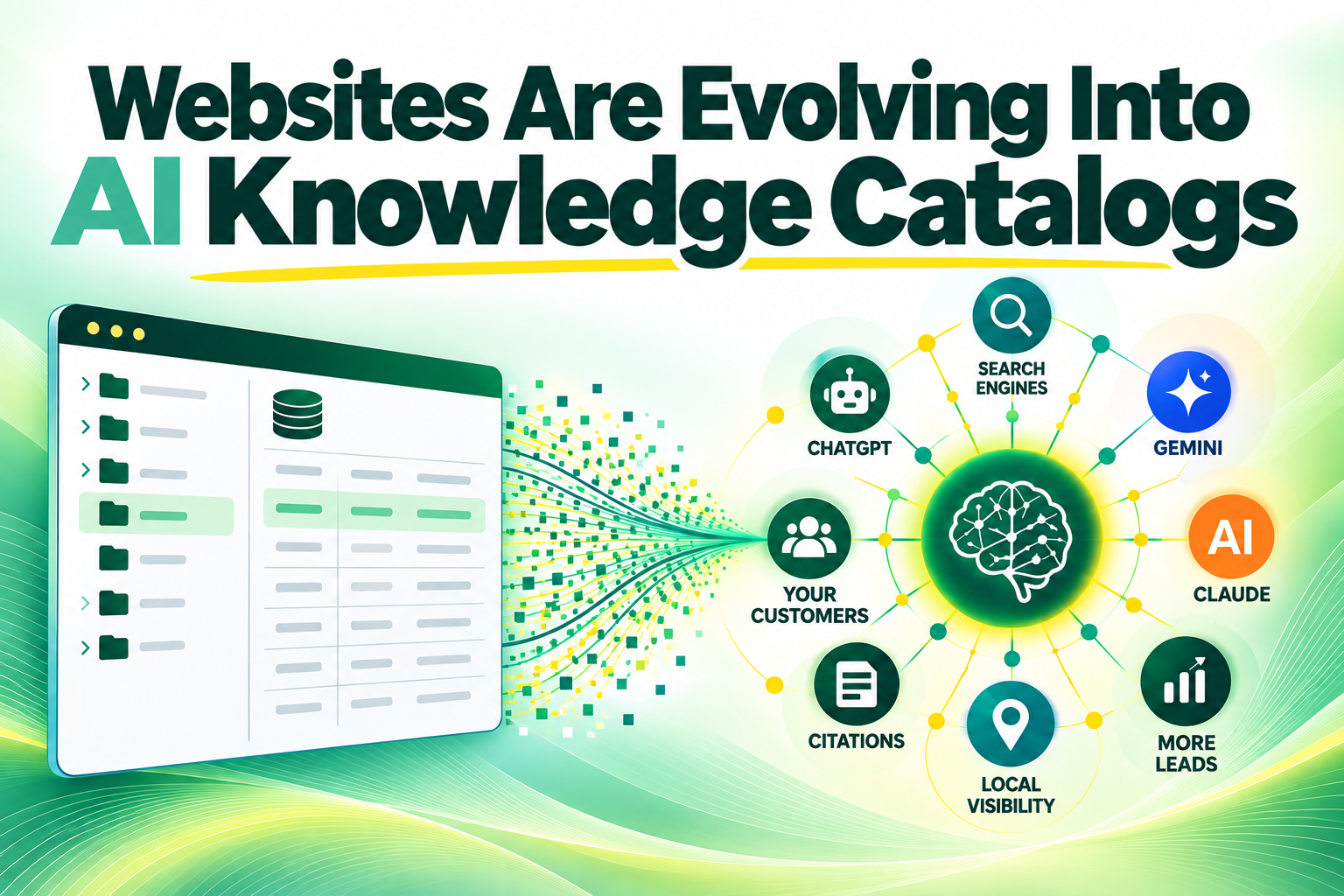
 The digital landscape is experiencing a seismic shift. For decades, business websites served primarily as marketing brochures—designed to persuade, convert, and capture leads. But as artificial intelligence reshapes how people discover and evaluate businesses, websites must evolve to serve a new master: the AI systems that increasingly act as gatekeepers between companies and customers. Your website functions as an AI knowledge catalog when it provides clear, structured answers to the questions AI systems ask. This isn’t just about SEO anymore; it’s about ensuring that when ChatGPT, Google’s AI Overviews, or any other intelligent assistant looks for information about your business, it finds everything it needs to confidently recommend you.
Understanding How AI Discovers Businesses Online
The process of how AI discovers businesses relies heavily on the quality and structure of information available online. Unlike traditional search engines that simply match keywords and rank pages, AI systems actually read, interpret, and synthesize information to answer specific questions. When someone asks an AI assistant for a recommendation—whether it’s “What’s the best project management software for remote teams?” or “Find me a reliable plumber in Seattle”—the AI doesn’t just return a list of links. It evaluates businesses, compares options, and makes recommendations based on the information it can access and understand.
Understanding how AI discovers businesses reveals why traditional marketing websites fall short in the age of intelligent assistants. These systems look for specific signals: clear business information, detailed service descriptions, pricing transparency, customer reviews, technical specifications, and answers to common questions. If your website is built primarily to persuade rather than inform, you’re essentially invisible to AI. The assistant can’t extract the structured information it needs, so it moves on to competitors who have made their knowledge more accessible.
This shift represents a fundamental change in the relationship between businesses and their digital presence. Website optimization for AI goes beyond traditional SEO tactics to focus on machine readability and structured information. You’re no longer just competing for human attention; you’re competing to be the source that AI systems trust and reference when making recommendations.
The Fundamentals of Website Optimization for AI Systems
Successful website optimization for AI requires understanding how these systems parse and evaluate content. AI assistants don’t experience websites the way humans do—they don’t see beautiful designs or compelling hero images. Instead, they read the underlying code, looking for structured signals that help them understand what your business does, who it serves, and why it might be relevant to a user’s query.
The foundation of this optimization lies in semantic HTML and information architecture. Every page on your site should have a clear purpose and hierarchy. Your homepage shouldn’t just be a collection of marketing messages; it should clearly state what your business does, who you serve, and what problems you solve. Service pages need detailed descriptions, not just benefit statements. Product pages require specifications, use cases, and technical details—not just persuasive copy.
Preparing for AI-powered search means anticipating the questions AI will ask on behalf of users. Think about the information gaps that currently exist on your website. If an AI system wanted to recommend your business, what questions would it need answered? Can it easily find your pricing? Do you clearly explain your process? Are your service areas explicitly stated? Have you documented your expertise and credentials? Building an effective AI knowledge catalog requires rethinking how you structure and present information on your website.
AI-powered search fundamentally changes how users discover and evaluate businesses online. The old model of driving traffic to landing pages and using persuasive copy to convert visitors is giving way to a new model where AI systems pre-qualify businesses based on the completeness and clarity of their information. If your website can’t answer the AI’s questions, you won’t even make it into the consideration set.
Implementing Structured Data for AI Comprehension
Structured data for AI acts as a translation layer between human-readable content and machine understanding. While humans can infer meaning from context, AI systems benefit enormously from explicit markup that identifies what different pieces of information represent. This is where schema markup becomes critical.
Implementing schema markup for business helps AI systems quickly identify key information about your company. Schema.org provides standardized vocabularies for marking up everything from your business name and address to your products, services, reviews, and FAQs. When you add this markup to your website, you’re essentially providing AI systems with a structured index of your business information.
Consider a law firm’s website. Without structured data, an AI system sees paragraphs of text about legal services. With proper schema markup, it can instantly identify: the firm’s practice areas, the attorneys and their specializations, the jurisdictions they serve, their years of experience, client testimonials, and answers to common legal questions. Implementing structured data for AI helps search engines and assistants understand the context and relationships within your content.
But schema markup for business creates a structured framework that AI can easily interpret and reference—it’s not just about adding code to your pages. You need to think strategically about what information matters most for AI discovery. Start with Organization schema to establish your business identity. Add LocalBusiness schema if you serve specific geographic areas. Use Product or Service schema to detail your offerings. Implement FAQPage schema to make your Q&A content easily accessible. Each piece of structured data makes it easier for AI systems to understand and reference your business.
Building a Website Knowledge Base That AI Can Navigate
A well-organized website knowledge base serves both human visitors and AI systems seeking authoritative information. This goes beyond having a simple FAQ page. Your website knowledge base should answer questions thoroughly rather than just promoting products or services. Think of it as creating a reference library about your business, industry, and expertise.
The shift toward an AI knowledge catalog model represents a fundamental change in web design philosophy. Instead of organizing content around the customer journey or sales funnel, you organize it around topics and questions. Each page becomes a definitive resource on a specific subject, providing complete information rather than teasing details to encourage contact form submissions.
For example, a SaaS company might traditionally have a features page with brief descriptions and calls-to-action to “Learn More” or “Request a Demo.” In the AI knowledge catalog model, each feature gets its own detailed page explaining what it does, how it works, who it’s for, what problems it solves, technical requirements, pricing implications, and integration options. This level of detail might seem like it gives away too much information, but it’s exactly what AI systems need to make informed recommendations.
Your website knowledge base should also include resources that demonstrate expertise: detailed guides, case studies with specific outcomes, industry insights, and thought leadership content. AI systems evaluate authority based on depth and breadth of knowledge. A website with dozens of thin pages ranks lower in AI assessment than one with fewer but more thorough resources.
Practical Steps for AI Search Optimization
AI search optimization requires a shift from keyword targeting to entity-based information architecture. Start by auditing your current website through the lens of AI discovery. Ask yourself: If an AI system landed on each page, could it clearly understand what that page is about and extract the key information? If not, you have work to do.
Begin with your core business information. Create or update an “About” page that clearly states what your business does, your history, your team, your values, and your differentiators. Don’t bury this information in marketing speak—state it plainly. Add Organization schema markup to make this information machine-readable.
Next, audit your service or product pages. Each offering should have its own detailed page with complete information. Include specifications, pricing (if applicable), use cases, benefits, limitations, and frequently asked questions. Add appropriate schema markup for each offering. Entity-based SEO focuses on establishing your business as a recognized authority on specific topics, and detailed service pages are foundational to this.
Create a robust FAQ section that addresses real questions your customers ask. Don’t just include softball questions that lead to sales pitches. Answer the hard questions too—the ones about pricing, limitations, comparisons to competitors, and potential drawbacks. AI content discovery relies on clear information hierarchies and semantic relationships between topics, and honest, thorough FAQs signal trustworthiness.
Implement technical optimizations that make your site more accessible to AI crawlers. Ensure your site has a clean, logical structure with descriptive URLs. Use semantic HTML5 elements (header, nav, main, article, aside, footer) to help AI understand page structure. Create an XML sitemap and keep it updated. Optimize page load speeds, as AI systems may deprioritize slow sites.
Finally, build topical authority through content depth. Instead of creating dozens of short blog posts targeting different keywords, create fewer but more authoritative resources that thoroughly cover important topics in your industry. Link related content together to help AI systems understand the relationships between topics. Effective AI search optimization means providing complete, authoritative answers rather than teasing information.
The Future of Business Websites
The evolution from marketing tool to AI knowledge catalog isn’t a temporary trend—it’s the new reality of digital business presence. As AI assistants become more sophisticated and more widely used, businesses that have invested in making their information accessible and structured will have a significant competitive advantage. Those still relying on traditional persuasion-focused websites will find themselves increasingly invisible in AI-mediated discovery.
This doesn’t mean abandoning marketing or conversion optimization. It means recognizing that the path to conversion now often runs through AI systems. Your website needs to convince the AI first, which then convinces the human. The good news is that websites built as knowledge catalogs tend to perform better for human visitors too. People appreciate transparency, detailed information, and straightforward answers.
The shift toward an AI knowledge catalog model represents a fundamental change in web design philosophy, but it’s also an opportunity. Businesses that embrace this evolution early will establish themselves as authoritative sources in their industries. They’ll be the ones AI systems confidently recommend. They’ll attract more qualified leads because visitors arrive already informed and convinced by the AI’s endorsement.
Start today by viewing your website through the eyes of an AI system. What questions can’t it answer? What information is hidden or unclear? What structure is missing? Then begin the work of transformation—not because it’s trendy, but because it’s essential for remaining discoverable and relevant in an AI-powered world. Your website is no longer just your digital storefront; it’s your knowledge catalog, your reference library, and your advocate in conversations you’ll never directly participate in. Make sure it’s ready for that role.
With switch of websites to becoming knowledge catalogs represents a radical alteration in web architecture. The focus moves from visual design to semantically structured information systems. Your website must now serve both human visitors and AI systems well. I walked you through implementing knowledge graphs that organize content around core entities and relationships. Then we applied schema markup to make this structure machine-readable. The sites that adapt now will dominate AI-powered discovery channels. Those that cling to traditional approaches risk becoming invisible to tomorrow’s search landscape.
FAQs
Q1. What exactly is a knowledge catalog in the context of websites? A knowledge catalog is a structured system that organizes and delivers information in a format that both search engines and AI systems can easily understand. Unlike traditional websites that focus primarily on visual design and navigation, knowledge catalogs use semantic structures to aggregate information, define relationships between content pieces, and present data in a machine-readable format that AI assistants can parse and reference as authoritative sources.
Q2. How do knowledge catalogs differ from traditional website designs? Traditional websites prioritize visual appeal and user navigation, while knowledge catalogs focus on semantic organization and structured data. Knowledge catalogs unify technical metadata, operational intelligence, and business semantic models into an executable context graph. They organize information with clear entity relationships and implement schema markup, making content accessible to both human visitors and AI-powered search systems equally well.
Q3. Why are search engines now prioritizing knowledge-based website structures? Search engines have evolved from simple keyword-matching to entity-based systems that understand user intent and context. Google’s Knowledge Graph and AI-powered tools like AI Overviews now extract direct answers from websites rather than just listing page links. This shift means search engines favor sites with structured data, clear semantic connections, and content that demonstrates expertise and trustworthiness through organized, easily parsable information.
Q4. What technical elements should I implement to build my website as a knowledge catalog? Start by creating a knowledge graph that defines your core entities (brand, products, services, topics) and maps their relationships. Implement Schema.org structured data using JSON-LD format across key pages. Organize related content around central themes, maintain consistent terminology throughout your site, and use internal links to create semantic connections. Validate your markup using tools like Google’s Structured Data Testing Tool to ensure AI systems can correctly process your content.
Q5. How does optimizing for AI systems affect my website’s visibility? Websites optimized as knowledge catalogs gain visibility through both traditional search and AI-powered discovery channels like ChatGPT and Google’s AI Overviews. AI systems prioritize content that’s structured with FAQs, how-to lists, and schema markup from sites demonstrating expertise and authority. By implementing semantic structures and machine-readable data, your content becomes discoverable through conversational AI searches and gets cited as an authoritative source in AI-generated responses.
We Help Clients With Websites, SEO, Content, Email Marketing, and AI!
Our BUSINESS GROWTH ECOSYSTEM™ is the perfect mixture of online marketing and partnership marketing that achieves a consistent flow of leads for our clients. It’s a complete marketing system designed to help small businesses attract, convert, and nurture more customers by combining multiple growth engines into one connected strategy. The package includes a high-converting website, landing pages, lead capture systems, conversational AI, AI Search Optimization, pillar content strategy, educational blogs, client results posts, video lead generation, SEO, social media management, email marketing, local SEO, and authority-building content that helps prospects discover your business, trust your expertise, and take action. It also includes strategies to showcase your success through proof marketing and create stronger referral relationships through partnership marketing and the Guest to Growth™ video podcast strategy, helping your business generate more leads, build authority, and create long-term growth.
> Learn More
Contact us (859-904-8035) today to get started!
—
 ABOUT MAIN STREET MARKETING
 ABOUT MAIN STREET MARKETING
Main Street Marketing’s BUSINESS GROWTH ECOSYSTEM™ is a complete marketing system designed to help small businesses attract, convert, and nurture more customers by combining multiple growth engines into one connected strategy. The package includes a high-converting website, landing pages, lead capture systems, conversational AI, AI Search Optimization, pillar content strategy, educational blogs, client results posts, video lead generation, SEO, social media management, email marketing, local SEO, and authority-building content that helps prospects discover your business, trust your expertise, and take action. It also includes strategies to showcase your success through proof marketing and create stronger referral relationships through partnership marketing and the Guest to Growth™ video podcast strategy, helping your business generate more leads, build authority, and create long-term growth.
>> Learn More